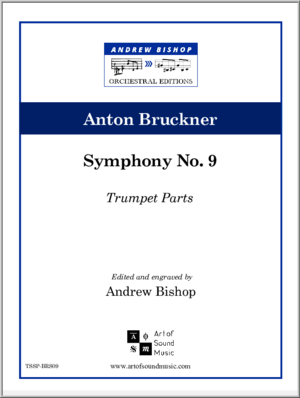

Bruckner Symphony No. 9
| Arranger | Bishop, Andrew |
|---|---|
| Composer | Bruckner, Anton |
| Duration | 60 |
| Ensemble | Trumpet |
| Genre | Classical |
| Grade | 4 |
| Model Number | TSSP-BRS09 |
| Category | Orchestral Trumpet Parts, Solo Trumpet |
This professionally re-engraved and transposed set of orchestral trumpet parts greatly eases learning and performance of the work. Available as PDF download or hard copy (9″ x 12″). You can buy the parts individually or as a package:
- Trumpet 1 in C
- Trumpet 2 in C
- Trumpet 3 in C
Notes from the Editor
Many Bruckner Symphonies have significant engraving issues. I have modernized the Symphony No. 9 parts in the following manner:
All unnecessary rehearsal numbers reflecting 10 measure increments have been deleted.
All parts appearing as Trumpet in F have been changed to Trumpet in C. Because everything now appears in concert pitch, proper enharmonic spelling of notes has been implemented. In addition, passages including an obscene amount of ledger lines in the Tpt. 3 part are now much more readable.
A new system of cues have been created. The original engraving of Bruckner 9 is rife with an unruly amount of cued passages. I have deleted the excess, and added other more helpful cues – especially showing cues of other trumpet parts to facilitate staggered entrances, etc.
Modern music engraving practices involving the appearance of quarter-note triplets and slurring over tied note passages have been employed.
The 2005 Musikwissenschaftlicher Verlag edition by Benjamin-Gunnar Cohrs was used as a reference for creating this edition.
The Andrew Bishop Orchestral Editions explore the concept of how these orchestral masterworks would appear if they were composed today. There are myriad differences in how music is currently published compared to when many of these works were originally engraved. “Tradition” is usually the (poor) excuse I hear when the topic of updating these masterworks is discussed – most often in reference to transposition(s). As a performer and teacher, I remain committed to the practice of honing vigorous transposition skills. However, there are many of these original engravings set in keys that are truly antiquated, and make almost no sense whatsoever to keep perpetuating. Transposition, however, is the least of the issues most of these original editions suffer from. Paper is no longer a premium and scarce product, and therefore the practice of cramming as much material on a page is not necessary. “Readability” was obviously not a concern with copyists of the times, and it is my opinion that the music suffered because of it. Therefore, a ”Bish Edish” (as they are popularly referred to) features many upgrades, including:
- Judicious spacing throughout the engraving (not too cramped, not too open)
- Correct enharmonic spellings of notes. This is an unfortunate byproduct of writing in asinine transpositions.
- A careful reconsidering of cue usage.
- Corrections of many inconsistencies between original parts and score, and even between parts themselves.
- The addition of measure numbers, including helpful ranges listed under multi-measure rests.
- Deleting key signatures and writing all parts utilizing accidentals only.
- All parts are formatted for standard Concert 9×12 paper, and is best printed on that size.
Reading it on 8.5×11 is not ideal, but the compression percentage isn’t too significant. Similarly, reading it off a larger tablet (e.g. iPad Pro) doesn’t present any significant issues.
In some instances, there are other upgrades specific to individual works that will be mentioned within the respective product. If you happen to find something questionable that you would like to bring to my attention, please feel free to do so at: [email protected]. If it is something that I need to correct, I will be happy to do so and make sure you receive a corrected part/parts. If you have other works that you would like to have a custom edition made, please also reach out with that as well.
Andrew Bishop, Editor
Related products
-
 Price range: $40.00 through $60.00
-
Price range: $13.00 through $28.00
-
Price range: $14.00 through $32.00
-
$6.00
-
Price range: $12.00 through $35.00
-
$10.00